The Anatomy of an Addictive Game: How Last War: Survival Made $2.6 Billion
A game-design deconstruction of Last War: Survival, the $2.6 billion mobile hit. How its hyper-casual ads, 4X strategy core, alliance social loops, live-ops events, and monetization architecture combine to create one of the most compulsive games on mobile.
Code Crush Team
Gamification Agency
Updated May 22, 2026
What Last War: Survival Actually Is
Last War: Survival is a free-to-play mobile strategy game developed by the studio First Fun — later published under FUNFLY PTE. LTD. — and released globally in August 2023.
On the surface it looks like a casual reflex game. In reality, it is a finely tuned machine for capturing the time and money of millions of players — and it has done so to the tune of over $2.6 billion in player spending.
Beneath the swipe-to-shoot ad is a 4X strategy game — the genre defined by the loop eXplore, eXpand, eXploit, eXterminate — wrapped in a post-apocalyptic zombie skin. It sits in the lineage of Clash of Kings, Rise of Kingdoms, and Whiteout Survival.
That pedigree is no accident. First Fun's founder, Xie Xian Lin, was the founding CTO of Elex Technology, the studio behind the billion-dollar 4X title Clash of Kings. The same network previously built Top War. Last War is a 4X "greatest-hits" machine built by veterans who already knew the formula — they just bolted a brilliant new front door onto it.
The Numbers That Make It Worth Studying
MetricFigure
Lifetime player spending$2.6B+ (passed $2B in Feb 2025)
2024 revenue$1.1B+ — a top-5 grossing game of the year
Monthly revenue growth in 2024$30M in January to $138M in December (~360%)
Antony Starr ad campaign12.5M+ downloads, #1 most-downloaded in the US
Revenue per monthly user (ARPMAU)$12 in the US, $31 in Japan
So the question worth answering is not whether this game is "good." It is: how is this machine engineered to extract this much money and time from people? Below, every part is taken apart — illustrated with screenshots from a live warzone — and there are real, repeatable lessons here for anyone who designs engaging experiences.
A Game Built in Two Layers
Last War only works because it is deliberately two games stacked on top of each other.
Layer 1 — The Hook. A hyper-casual, five-minute reflex minigame. This is what you see in the ads, and what you play first. Its job is to convert — cheaply and universally.
Layer 2 — The Machine. A deep, slow, social 4X strategy game. This is what you actually end up playing for months, and paying for. Its job is to retain and monetize.
The genius is the seam between them. Most strategy games scare off casual players in the first 60 seconds. Last War spends the first five minutes pretending to be something else entirely, then quietly swaps the engine while you are still having fun. Each layer is engineered for a different psychological job: the Hook converts; the Machine retains and monetizes.
Part One — The Hook: The Hyper-Casual Minigame
What It Is
The famous ad — and the real opening of the game — is a "math-gate" lane-runner shooter, surfaced in-game through modes like Frontline Breakthrough. Mechanically:
Your squad of soldiers runs automatically down a lane — an "on-rails" runner.
The screen throws gates at you, each labeled with an operation: +15, x3, -20, ÷2.
You swipe left and right to steer your blob of soldiers through the better gate. Choose x3 over +10 and your squad multiplies.
Soldiers auto-fire at incoming zombie waves — a bigger squad means more firepower. Some power-ups boost it; some traps cost you troops.
Each run climaxes in a boss fight — a clean, satisfying spike of tension and payoff.
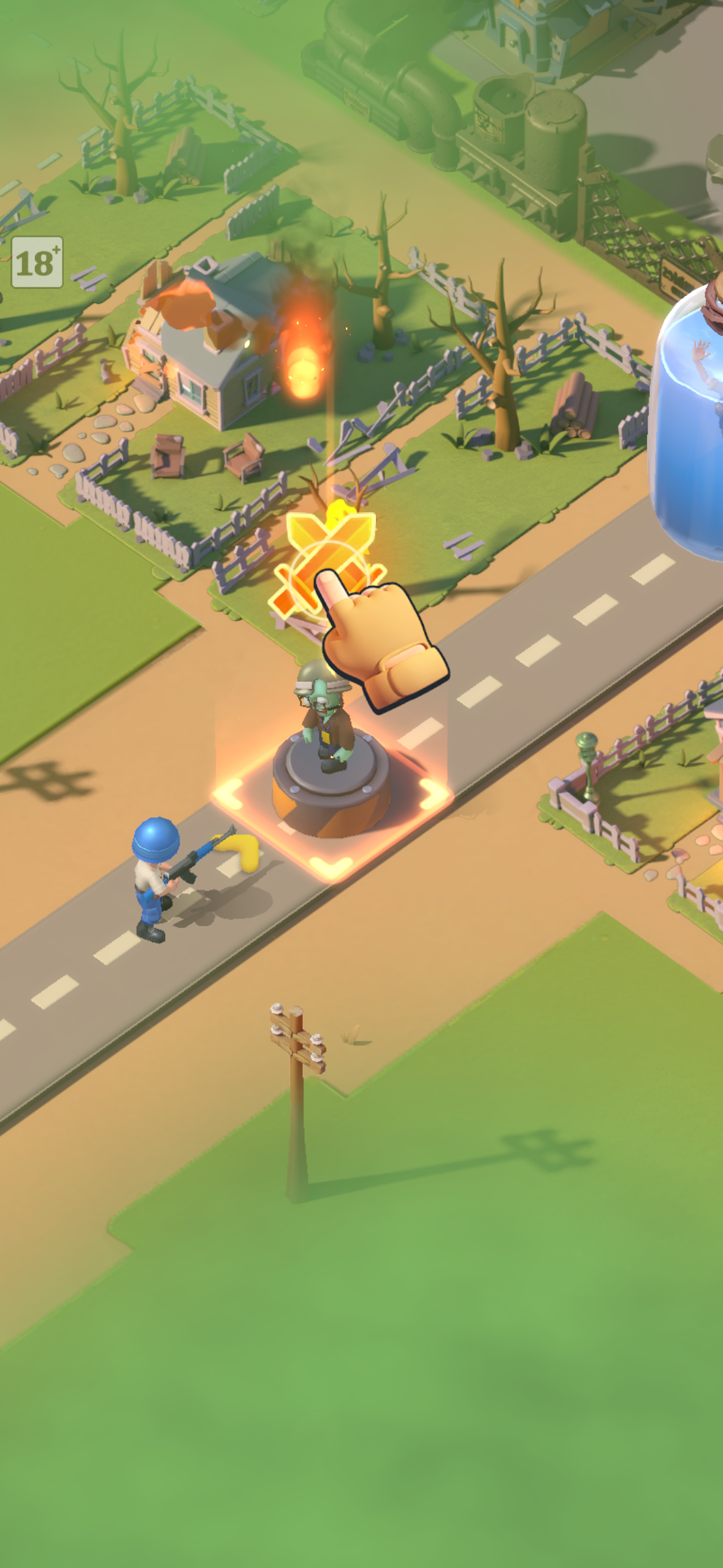
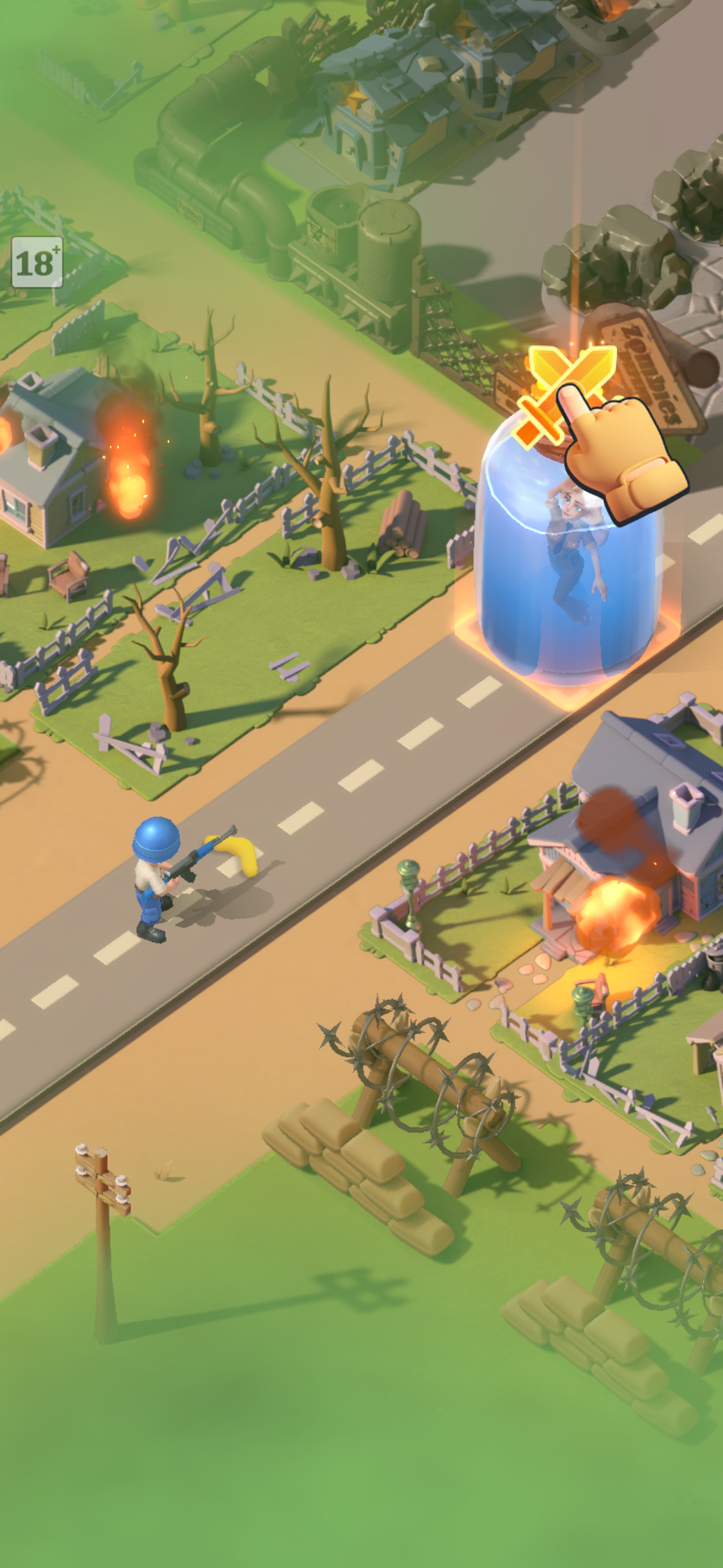
The game opens with the simplest possible tutorial: your blue soldier walks a post-apocalyptic road while a giant pointer finger hovers over a single zombie idol — the only possible target. Burning houses smoke in the background. Everything communicates in a single frame: this world is on fire, you are the only hero, and the controls need no explanation. One tap to begin.
The Lane Runner in Detail
The core action loop is a lane-runner — a narrow corridor with enemies advancing and resource pickups lining the edges. Every element is engineered:
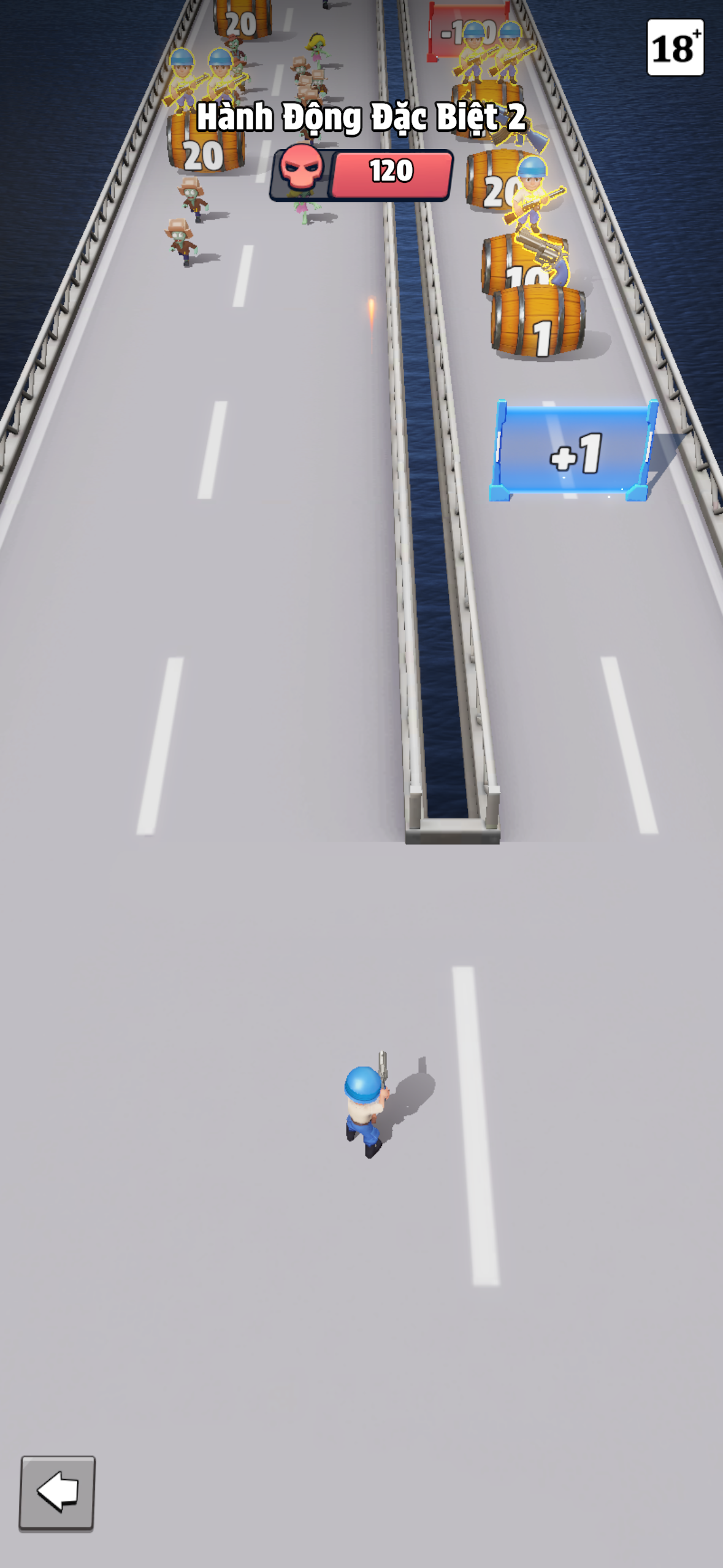
"Hành Động Đặc Biệt 2" (Special Action 2) in full motion: a blue soldier runs the center lane while a zombie enemy with a visible **120 HP bar** closes in. Barrels on the side offer +20 and +10 soldier bonuses. A "+1" reinforcement tile sits in the corner. Every element in this frame is a live micro-decision: which lane, which barrel, how to thread the gap.
The HP bar (120). The enemy's health is displayed numerically, letting the player calculate exactly how many soldiers are needed to win. This is not random — it turns pure reflex into a live math challenge.
The barrel pickups (+20, +10). Placed away from the center line, they force a choice between the safe path and the bonus — the classic risk/reward lever that keeps skilled players leaning forward.
The "+1" reinforcement counter. A constant drip of extra soldiers as a reward for forward progress. Even if you miss the barrels, you are always gaining — runs almost never feel like losses until the final moments.
The split lane. The corridor bifurcates, creating a forced choice with no time to think. This is the decision architecture that makes the minigame feel "skillful" while remaining instantly accessible.
The Completion Screen
The run ends not with a fade-to-menu but with a scored result screen built to trigger immediate replay.
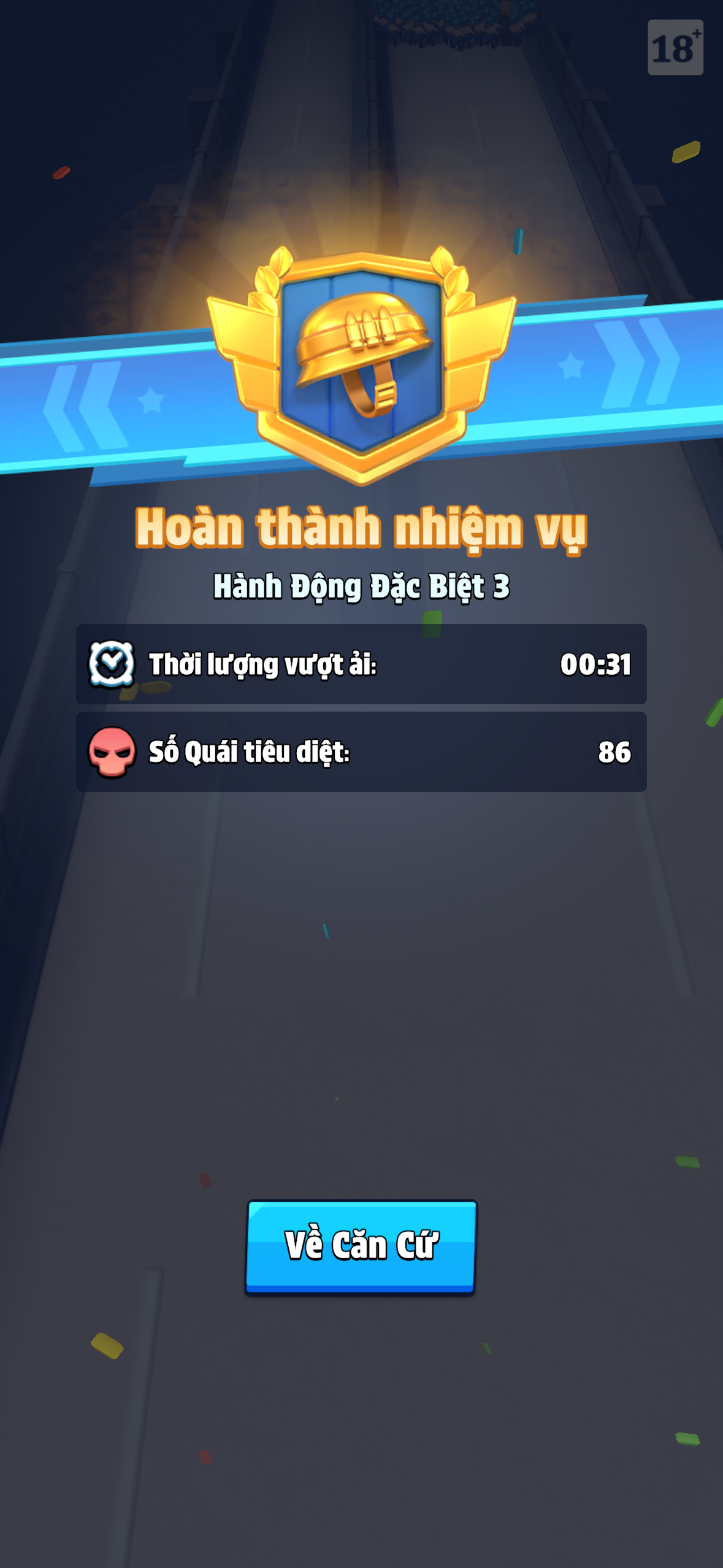
Special Action 3 completion screen ("Hoàn thành nhiệm vụ"): a gold medal, clear time **00:31**, and **86 zombies eliminated**. The result is brief and richly legible — every metric invites you to do better. The single "Về Căn Cứ" (Return to Base) button is the seam between the two games: there is no "play again" shortcut. The game enforces the transition.
The gold medal. A tiered reward — gold, silver, or bronze — ensures most runs feel achievable and perfect runs worth chasing. A grade is a commitment device: you want to beat it.
Clear time: 00:31. Thirty-one seconds, scored like an Olympic event. Time-based scoring turns a casual shooter into a personal record.
Zombies killed: 86. A second axis of mastery. Fast runs and high-count runs each feel optimal for different event objectives — giving players two separate reasons to replay the same map.
No "play again" button. The only exit routes back to the base. The game controls the transition, ensuring the strategy layer is always the destination.
Why This Design Is So Effective
This is a textbook hyper-casual experience, and every property is doing a job:
Zero learning curve. Swipe left or swipe right. A child or a 70-year-old can play instantly.
Constant micro-decisions. A choice every two seconds keeps the brain engaged with no downtime.
Visible, instant growth. Watching 8 soldiers become 240 is a pure, legible dopamine hit — the numbers go up, and you can see it.
Loss aversion built in. The -20 gates and troop-stealing traps mean every run carries the sting of almost doing better.
A boss as a full stop. The boss creates a clean beginning-middle-end arc inside 60 seconds, so each run feels complete.
This layer has one purpose: conversion. It moves the maximum number of people from "saw an ad" to "installed and enjoying themselves" — at a lower cost-per-install than almost anything else on the market.
Part Two — The Onboarding Funnel: The "Bait and Switch," Engineered
This is the single most studied design decision in the game. Last War's ads — predominantly the math-gate shooter — make up over 50% of its entire user-acquisition impression volume across TikTok, Instagram, Snapchat, and Facebook. Players widely call these ads "misleading," because the real game is a slow 4X strategy title.
But First Fun did something most "fake ad" games never do: they made the fake game real, and used it as a graduated tutorial.
Around 60% of the first four to five minutes of gameplay is the advertised shooter. The ad does not lie for the first five minutes — it delivers.
As you progress, the minigame appears less and less frequently.
In its place, the game slides in 4X missions: build a barracks, train troops, start research.
By the time the minigame has faded out, you are already several upgrades deep into a base you have an emotional stake in.
This is a commitment-and-consistency ramp. The player is never asked to "decide" to play a strategy game. They are simply having fun, then having slightly different fun, then — without a clear moment of choice — they are managing a city, in an alliance, with a build queue running.
The cost: an expectation mismatch. People who wanted a forever-runner feel cheated and leave. The payoff: an enormous top-of-funnel at a low price. The game knowingly trades retention rate for sheer acquisition volume — and because the players who do stay monetize extraordinarily well, the math works overwhelmingly in First Fun's favor.
Part Three — The Machine: The 4X Core Loop
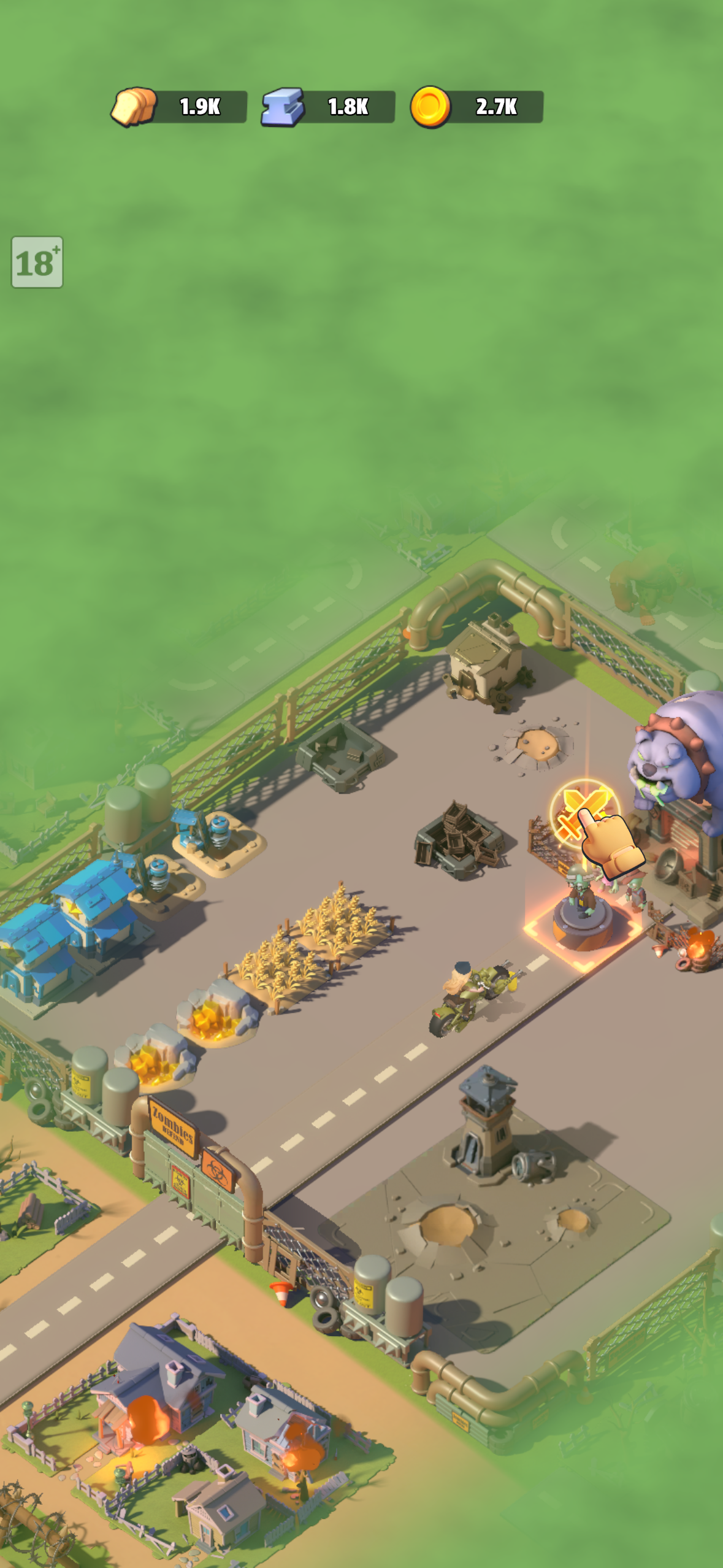
Once the minigame fades, the real game is revealed: a base-builder plus collection RPG plus territorial PvP. This is the screen players actually live in for months — a survivor base seen from above, soldiers drilling in the yard, resources ticking up around the clock.
The base in its earliest state: bare dirt, a handful of starter buildings, and a Lucky Wheel sitting center-stage. There is almost nothing here — and that is deliberate. An empty base is a blank canvas the game hands you and says "fill this." Every building you unlock transforms that dirt into something *you* built, something that feels like yours. Ownership is manufactured before you have done anything meaningful.
Here is each subsystem, and the psychological lever it pulls.
The Base and Headquarters
You run a survivor shelter as mayor, commander, and quartermaster at once. The Headquarters (HQ) is the spine of progression: its level gates every building, troop tier, and feature. New troop tiers unlock at HQ milestones (HQ 10, 13, 17, 20, and up — all the way to T10 troops). You cannot rush one system — the HQ forces balanced, broad-front progress, which means more things to upgrade, always.
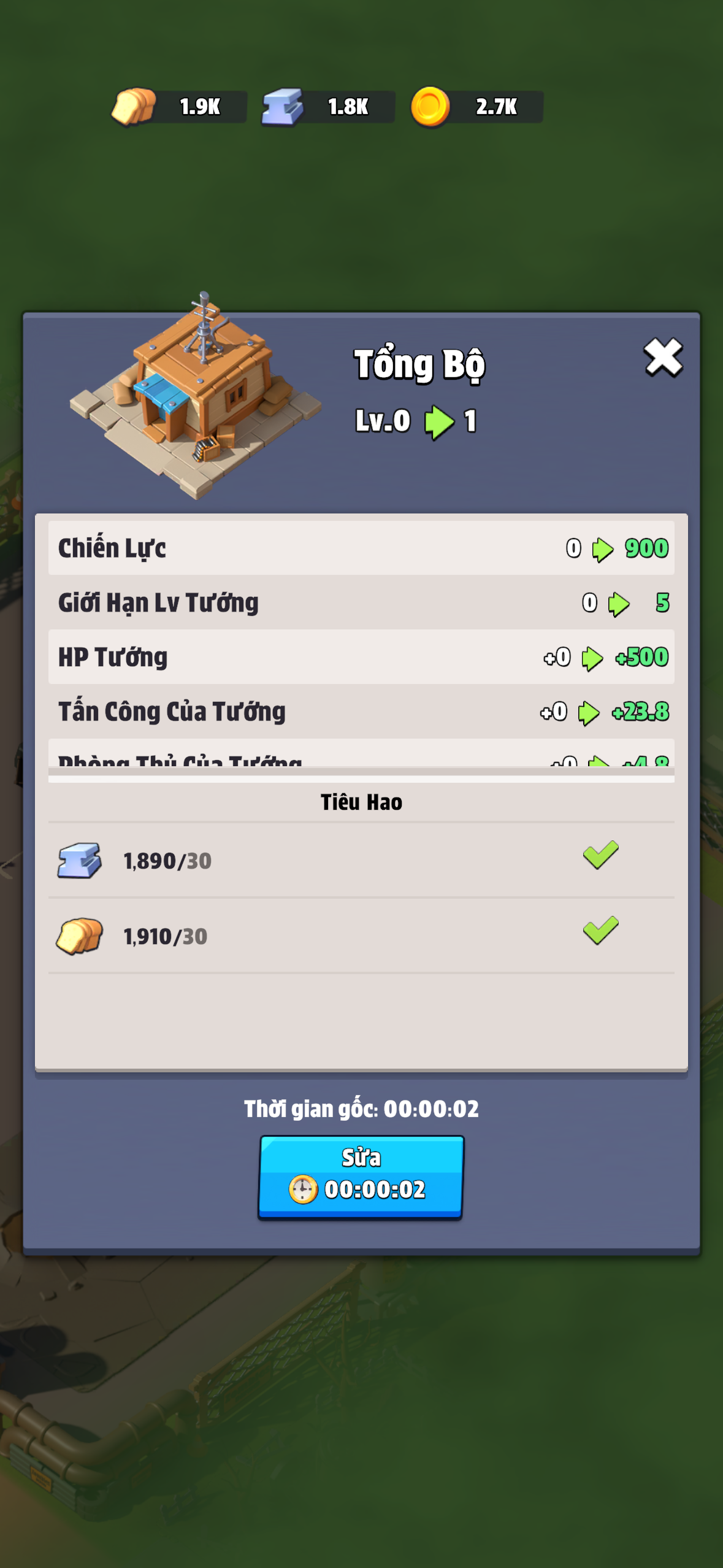
The HQ upgrade panel (Tổng Bộ Lv.0 → 1): every stat change is printed precisely. Power jumps from 0 to **900**. Hero Level Limit (Giới Hạn Lv Tướng) opens from 0 to **5** — heroes cannot level past 5 until this building is upgraded. Hero HP gains +500, hero attack gains +33.8, hero defense opens as well. Cost: 1,890 iron and 1,910 food. Build time: just 2 seconds for the very first upgrade — deliberately painless to start the upgrade habit.
The HQ panel reveals a pattern that appears everywhere in Last War: the gating cascade. Every row is a key that unlocks something else. Upgrading the HQ is not one action — it is the key that enables five parallel upgrade queues. This is deliberate: there is never a moment of "I have nothing to do." There is always a next gate, and behind every gate is another queue.
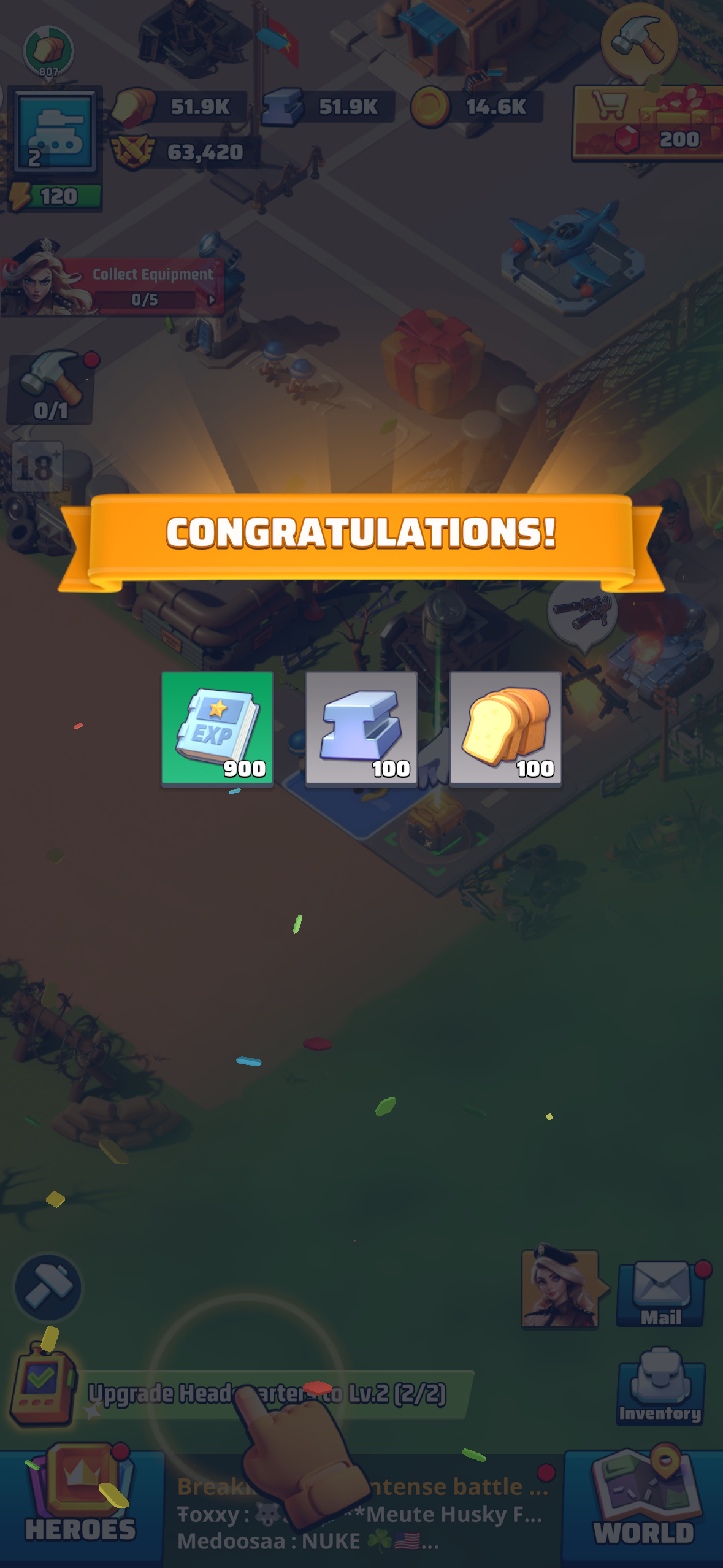
After every HQ level-up, the game punctuates the moment with a reward popup — a brief golden ceremony around an incrementing number.
"CONGRATULATIONS!" — the HQ level-up reward screen delivers 900 EXP, 100 iron, and 100 food. The reward is modest in absolute terms. The visual treatment is not: golden banner, confetti, oversized icons. This is a ceremony around a number incrementing by one. The brain responds to celebration regardless of the objective size of the prize — the dopamine hit from the fanfare is real even when the loot is small.
The reward popup is a variable-schedule ceremony: it appears at every level-up, but the rewards inside scale unpredictably. Sometimes it is extra speed-ups. Sometimes a rare hero shard. You never quite know — and that uncertainty is precisely why you want to open the next one.
The lever — the unfinished house. There is always a building mid-upgrade, always a "plus" badge, always a next level. The base is deliberately never "done."
The Home Base — A Living World That Waits for You
The base is not a static menu screen. It is an animated isometric diorama that changes as you play — and one that constantly signals activity even when nothing is happening.
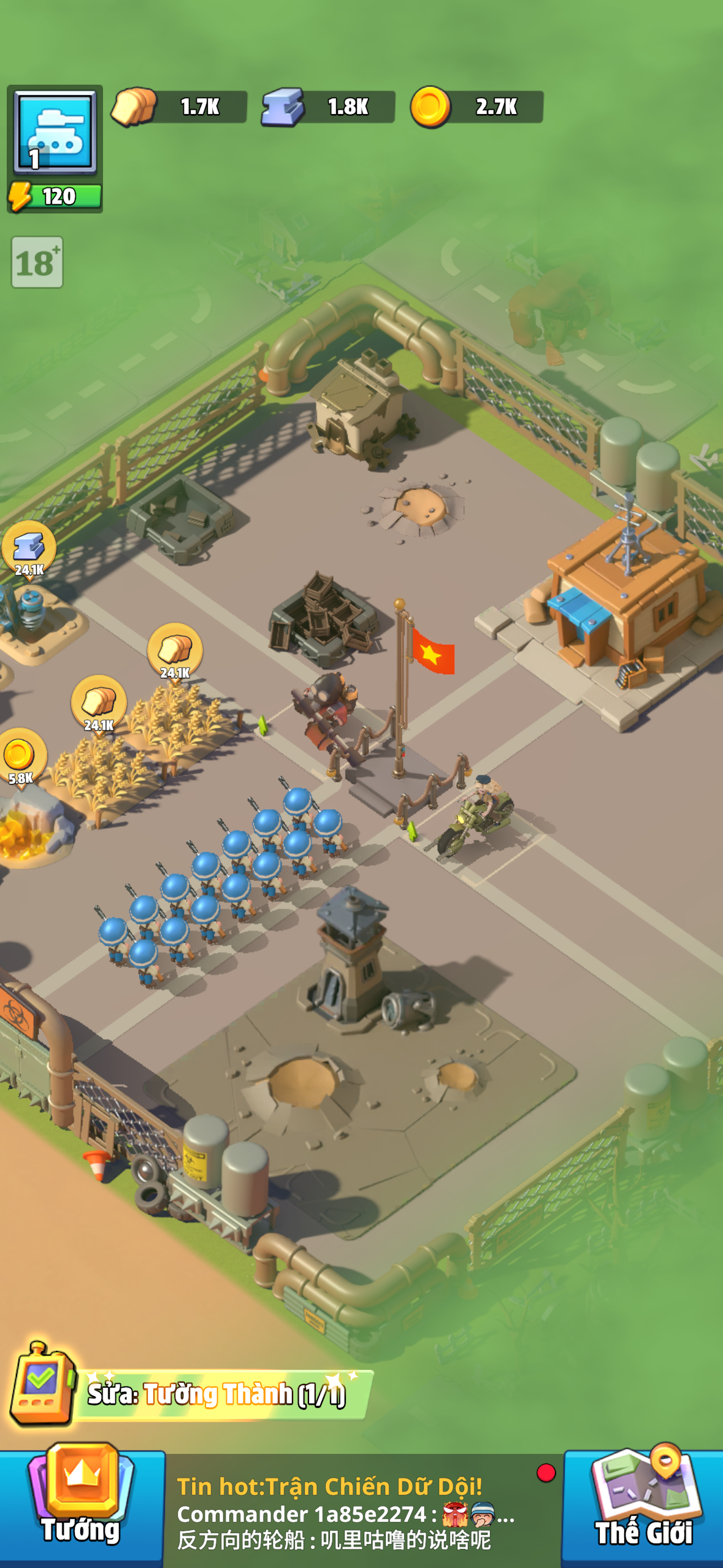
A developed base: rows of trained blue-uniformed soldiers drill on the parade ground, a Vietnamese flag marks the center, and live alliance chat scrolls at the bottom — "Tin hot: Trận Chiến Dữ Dội!" (Hot news: Fierce Battle!). The "Sức Tường Thành (1/1)" badge in the bottom bar signals a Wall repair waiting. The base is never quiet — it is teeming, and every element signals that something is always happening without you.
Every element in this screen is doing psychological work:
The soldier rows. Trained troops stand in visible formation. They are not an abstract number — they are your army, and every battlefield loss removes visible soldiers from your own parade ground.
The live chat ticker. Alliance messages scroll at the bottom even when you are not in chat, broadcasting that the world is active, that teammates need you, that something is happening right now without you.
The "Wall Repair (1/1)" badge. A repair pending is a chore uncompleted — an open loop that pulls the player back to close it.
The "Collect Equipment 0/5" counter. Unclaimed items feel like incomplete actions. The Zeigarnik effect — the brain's tendency to fixate on unfinished tasks — is baked directly into the UI.
Resources and the Idle Economy
The base runs on three core resources — food, iron, and gold — plus a premium currency (gems) and a wallet of special event currencies. Farms, factories and mines generate the basics around the clock, whether or not you are playing. Production collects into tap-to-claim bubbles that hover over the base.
That idle generation is doing quiet psychological work:
It rewards leaving and returning. Resources accrue while you are gone, so opening the app always pays out — a guaranteed small win on every single login.
It punishes absence without seeming to. Storage fills and bubbles cap out, so the longer you stay away the more you "waste" — a soft penalty the game never has to name.
The action game is on an energy leash. The minigame runs on a stamina meter — the energy bar by the base icon. It refills slowly in real time, so the very thing players came for is rationed, and the schedule of refills becomes a schedule of return visits.
The urgency signals are not limited to timers. Sometimes the game speaks directly.
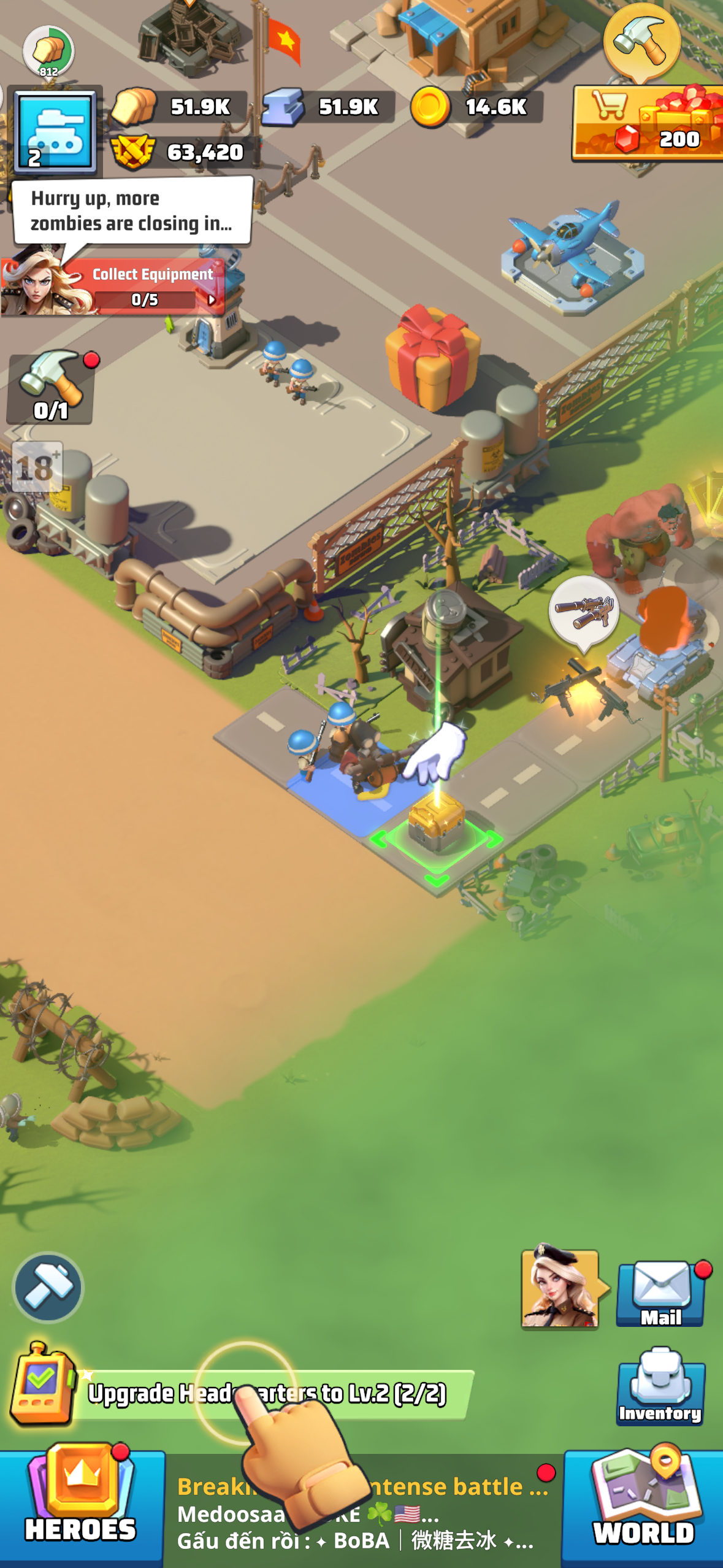
The base view interrupted by a live alert banner: **"Hurry up, more zombies are closing in..."** Resources read 51.9K gold, 51.9K iron, 14.6K food — a well-developed base, plenty to lose. A "Collect Equipment 0/5" prompt sits in the center. At the bottom: a prompt to upgrade headquarters, and a live alliance chat ticking with battle reports. Every element of this screen is communicating urgency, incompleteness, or imminent threat simultaneously.
The phrasing "closing in" does specific work: it implies movement, proximity, and limited time to act. Unlike a timer counting down, it triggers a threat-response rather than a scheduling response. You are not prompted to return when the timer ends — you are being told that something dangerous is happening right now. That distinction matters neurologically. Threat activates a different, faster system than deadline management, and it is much harder to rationally dismiss.
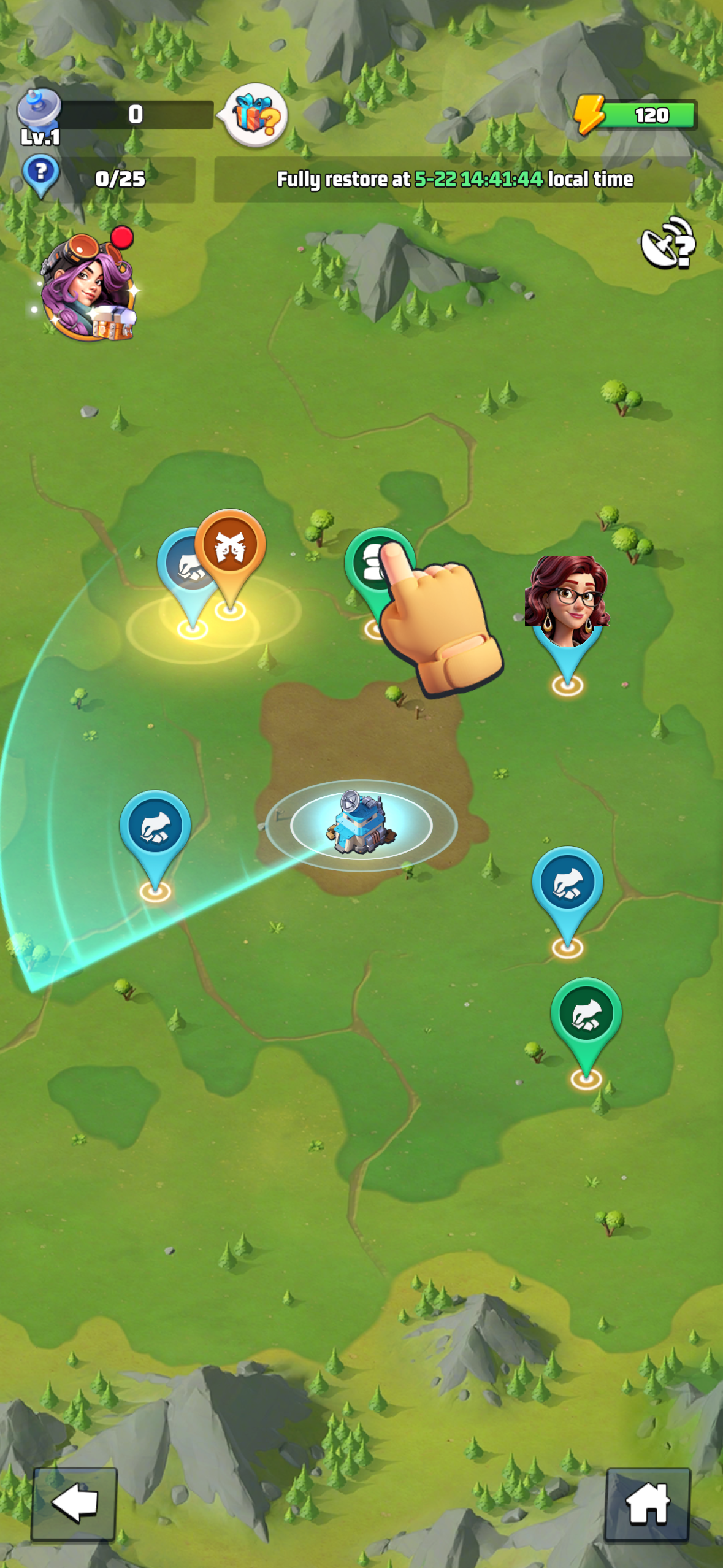
The energy system becomes fully explicit in the Radar Missions screen — arguably the game's most psychologically aggressive single mechanic.
The Radar Missions map with energy at **0/25** — fully depleted. Across the top bar, a precise message: "Fully restore at 5-22 14:41:44 local time." Four mission nodes sit ready: a burned-out objective, a completed route, two untouched destinations. Your hero portrait anchors the map. Everything is ready to go. Only the energy is empty — and the clock tells you exactly when to return.
This screenshot is worth a long look. The energy restoration message is displayed in local real-world time — not "42 minutes from now," but "14:41:44 today." That is not an accident. Converting a game timer into a clock appointment moves it out of the game world and into your actual daily schedule. The player now has a meeting at 2:41 PM — except the meeting is with a mobile game. This is the appointment mechanic at its most naked and deliberate. The game is not asking for your time. It is booking it.
Buildings, Power, and the Timer Economy
Every meaningful action runs on a real-time timer — a building upgrade takes hours, research takes hours or days, training troops takes hours. This is the core monetization engine: time is the currency, and the game sells time.
Speed-ups are consumables that skip timer minutes, hours, or days.
Build queues can be widened — extra construction lines are a classic first-purchase reward.
Idle resentment. A finished timer with nothing queued feels like waste. You are trained to log in just to "not waste a slot."
Every building also feeds one number: Power. Power is the universal score that folds your base, troops, heroes, research and gear into a single figure — the number rivals see, the number alliances rank you by, the number that ticks up every time you do anything at all.
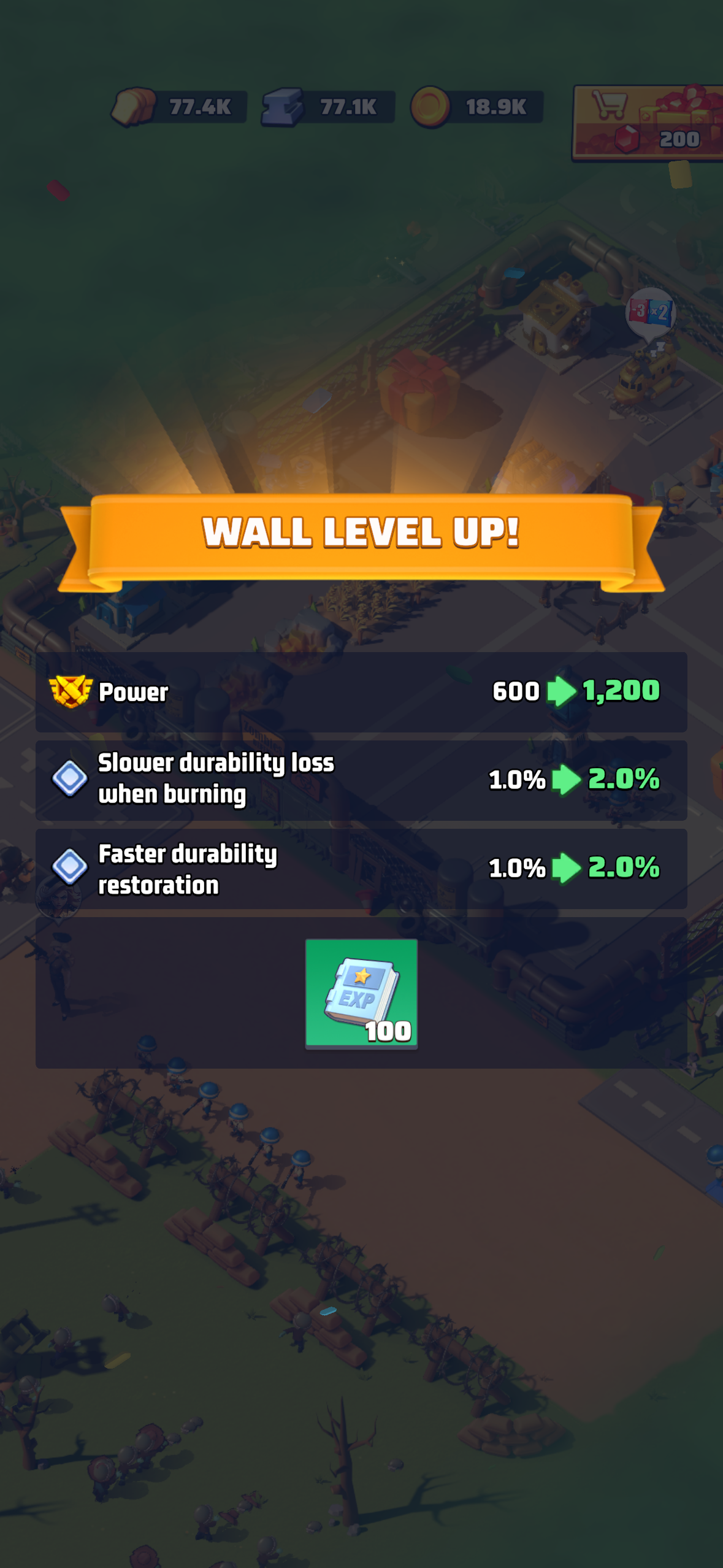
Every upgrade reports back in the universal currency of progress: Power. Here the Wall doubles a base's Power from **600 to 1,200** — and unlocks two new defensive stats: durability loss when burning slows from 1.0% to **2.0%**, and durability restoration after a fire speeds up from 1.0% to **2.0%**. The Wall is not just a number — it is a shield that becomes meaningfully better in the middle of an attack.
The Wall level-up exposes a quieter combat system. Buildings have durability and can be set on fire when your base is attacked. The "slower durability loss when burning" stat directly answers the question: what happens if I'm attacked while offline? The Wall doesn't prevent the attack — it buys time. Damage is visible on the base isometric view when you return, repair is a tappable chore, and a scorched base is a standing reminder that you were vulnerable. That visible damage is a retention mechanic — players return just to see what happened while they were away, and then stay to repair.
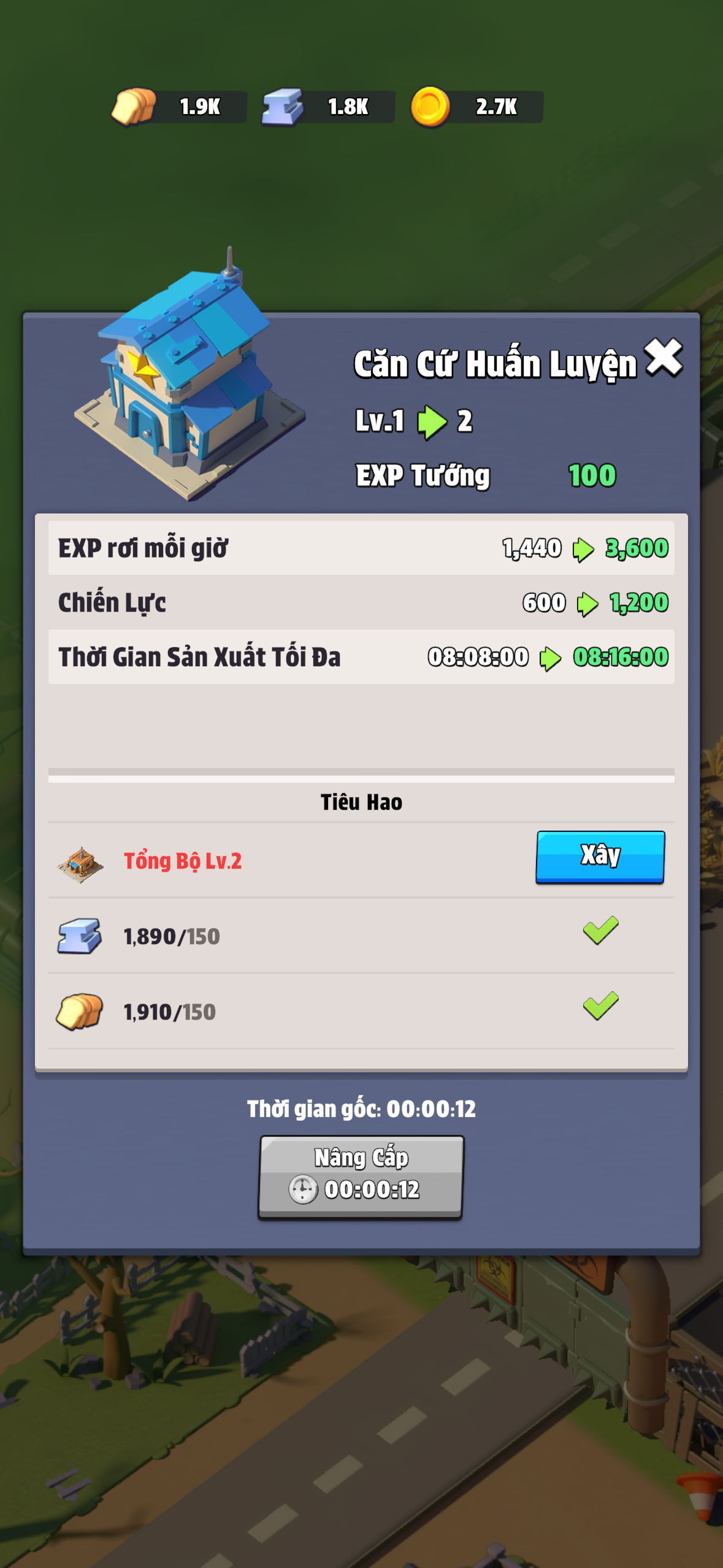
Beyond the Wall, other buildings produce resources over time — each with a production cap, a ceiling that stops accumulation after a fixed number of hours and forces you to log in before the cap is wasted. The Training Camp is a perfect example of this loop applied to hero progression.
The Training Camp (Căn Cứ Huấn Luyện) upgrade panel, Lv.1 → 2: Hero EXP per hour rises from **1,440 to 3,600**. The maximum production cap extends from **8 hours to 8 hours 36 minutes** — the camp stops producing EXP if you stay away longer than that. Power contribution doubles from 600 to 1,200. Requires HQ Lv.2 as a prerequisite — another gate in the cascade. Build time: just 12 seconds at this stage, scaling to hours at higher levels.
The Training Camp introduces a second idle timer loop stacked on top of the resource loop. It generates Hero EXP passively, but only up to the 8-hour cap. Leave for 12 hours and you silently "wasted" 4 hours of EXP production. This is loss aversion through absence: the game never announces the loss. It simply stops giving you things if you are not present — and the gap becomes visible the instant you return and see an empty progress bar instead of a full one.
The lever — sunk time and the appointment. You do not play Last War continuously — you check on it. Between build timers, refilling energy, collectible bubbles and repairs, the base quietly becomes a set of appointments threaded through your day.
Troops
Three unit types — Infantry, Ranged, and Vehicles — form a rock-paper-scissors triangle that rewards squad composition. Troops span tiers T1 to T10, and lower tiers can be promoted upward. They are not an abstract number, either: trained soldiers stand in visible ranks inside your base, a standing army that makes every loss in battle feel concrete. Troops are simultaneously your military power, your event currency (training them scores event points), and your loss exposure in PvP. That triple role means there is no such thing as "enough" troops.
Heroes — the Collection RPG Layer
Heroes are the commanders of your squads — and this is where the game becomes a gacha collection RPG. Heroes have rarities up to UR (Ultra Rare), unique skills, and types. They are acquired and upgraded via shards — and a hero is never simply "owned." Each one climbs a ladder of star ranks, and every star demands another stack of that hero's shards, so even a hero you already have is a permanently unfinished collectible. The shard economy is fed by a gacha system tuned to feel generous for common heroes but stingy for UR ones. The top UR heroes are kept scarce in the gacha — and made available earlier and more reliably through direct purchase or spend-based events. The gacha exists partly to make the paid heroes feel like the rational choice.
But before any spreadsheet of stats comes something more powerful: a narrative moment.
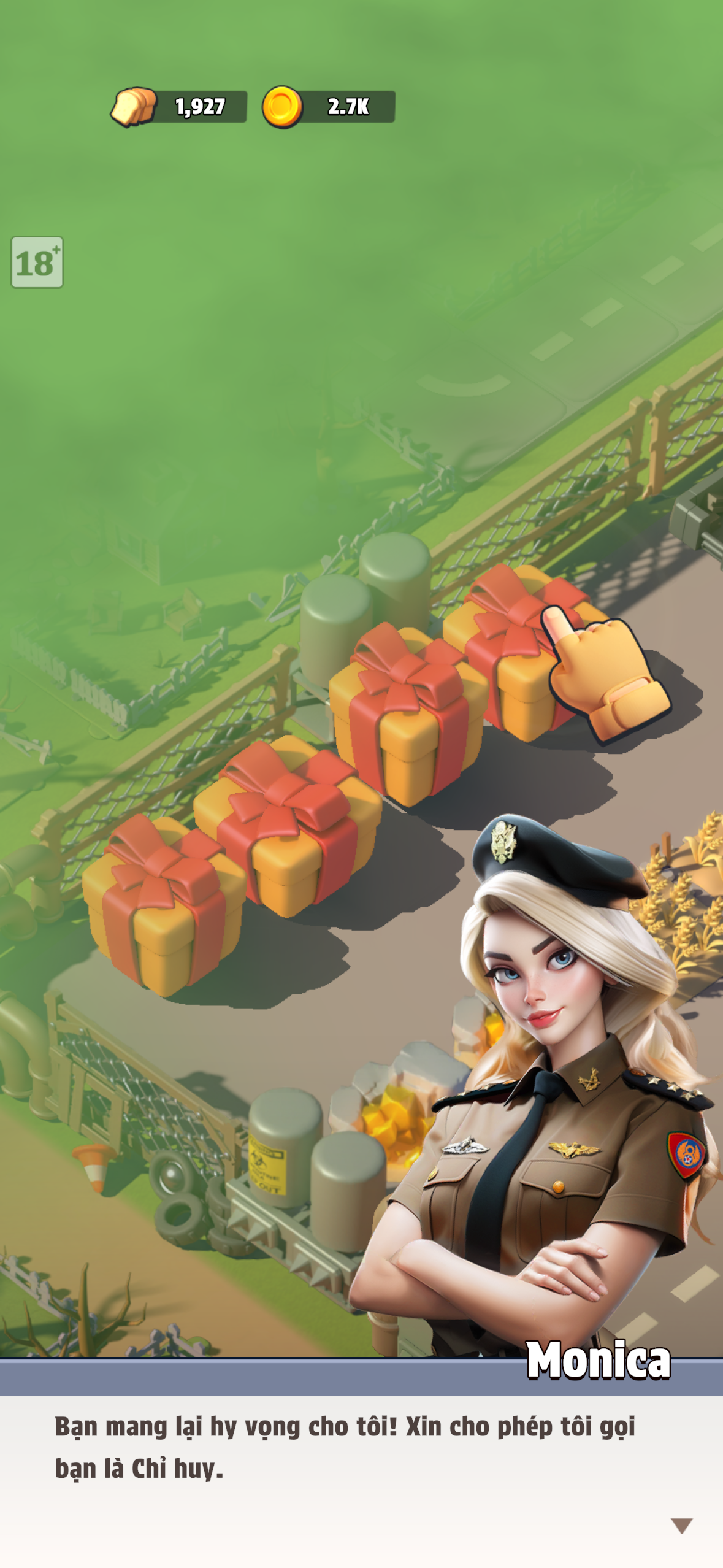
Monica's introduction: a confident military commander stands against the base backdrop, surrounded by glowing orange gift boxes she has just delivered. Her Vietnamese dialogue reads: "Bạn mang lại hy vọng cho tôi! Xin cho phép tôi gọi bạn là Chỉ huy." — *"You bring hope to me! Please let me call you Commander."* She thanks you. She names you. She brings gifts.
The Monica introduction is a deliberate exercise in character parasociality — an emotional bond between player and fictional character built through narrative framing:
She thanks you. "You bring hope to me" is not a status message. It is gratitude directed at you, the player. The character needs you.
She names you Commander. "Chỉ huy" is a form of address, not a game label. She is speaking to you personally, not about a role.
She brings gifts. The glowing gift boxes surrounding her at the moment of introduction are a behavioral technique: associating a new character with an immediate positive reward conditions warmth toward her before a single shard has been spent.
She has a face. A rendered, expressive portrait is an order of magnitude more emotionally salient than a numbered troop tier or a nameless squad. You will not forget Monica.
The hero summon itself has its own ceremony — a visible set piece that plays out inside the base world, not in a separate menu.
The hero summon animation mid-pull: a tall cylinder of electric blue light erupts from the base ground. A ghostly soldier silhouette shimmers inside it. Buildings around the cylinder are still burning — war is happening simultaneously — but the capsule holds the eye completely. The summon is not a menu transition. It is an event that happens *in your world*, making the gacha pull feel spatially and physically real.
The choice to surface the summon animation inside the base view — rather than in a disconnected gacha interface — is significant. The capsule appears on the parade ground you built, surrounded by the buildings you upgraded. That spatial grounding makes the reveal feel earned and real. When the soldier emerges, it feels less like a random digital drop and more like someone who just arrived at your base.
The lever — collection compulsion and the power gap. An incomplete roster is an itch. And because heroes are squad multipliers, a missing UR hero is also a visible, measurable competitive disadvantage.
Squads and Gears
Squads are formations — which heroes lead, which troop types fill them, how they synergize. Gears are craftable, upgradeable equipment that boost hero attack and defense. Together they add theory-crafting depth: there is a "right answer" to chase for every squad, which keeps engaged players reading guides, watching videos, and tinkering. An entire ecosystem of community sites exists purely to optimize this.
Tech Research — the Compounding Trap
The Research, or Tech Center, is a sprawling tree of permanent upgrades. Two design choices make it psychologically sharp:
It is irreversible. Every node you unlock stays unlocked — and every day spent researching the wrong node is compounding growth you can never recover. This creates genuine research anxiety.
A second research queue exists. Players who unlock or buy it compound at double the rate and pull permanently ahead — pressuring everyone else to follow.
The lever — compounding plus irreversibility. Together they manufacture a fear of falling behind that can never be undone.
Part Four — The World Map: Where the Strategy Actually Lives
The base teaches you the game. The world map is where the game is actually played — and it is the strategic heart of Last War, so it is worth slowing down on.
One Map, Thousands of Rivals
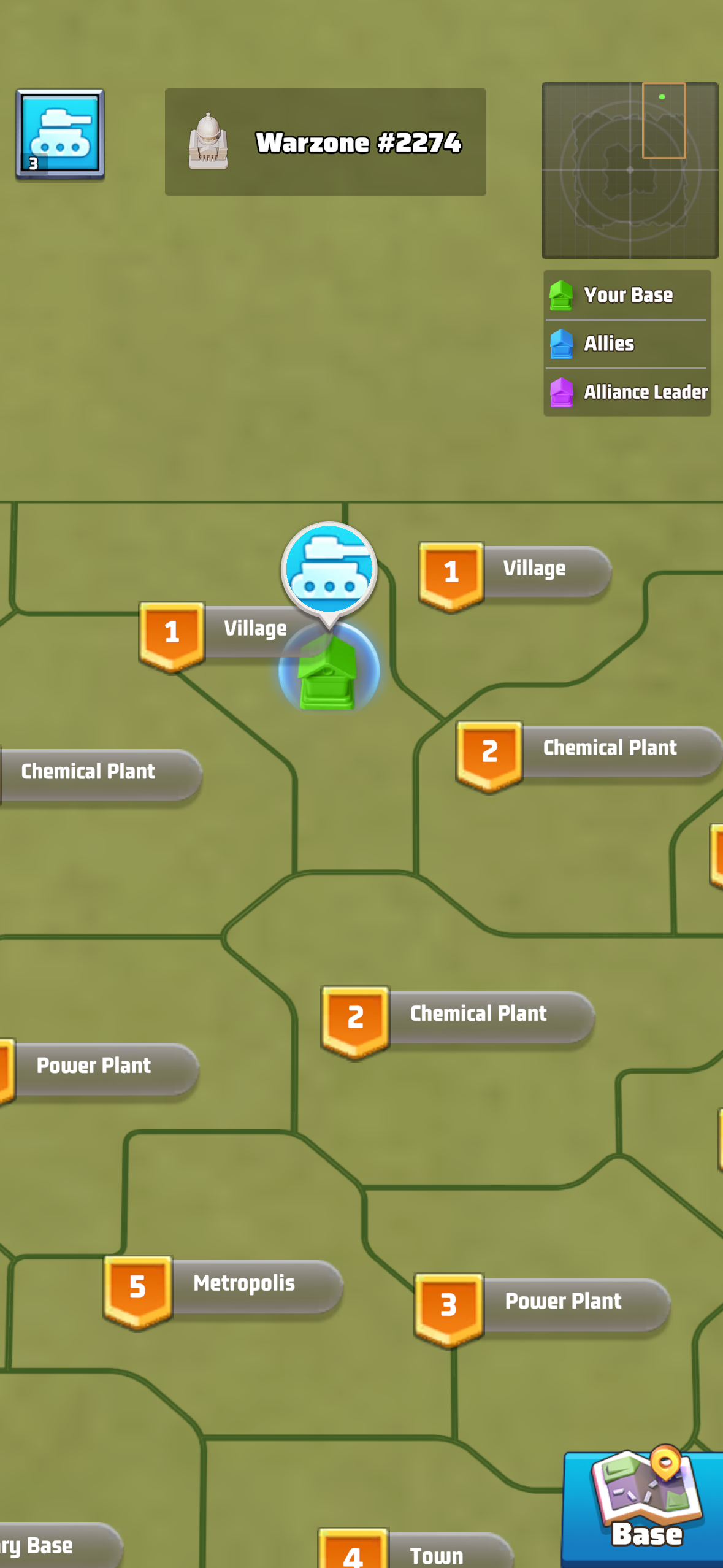
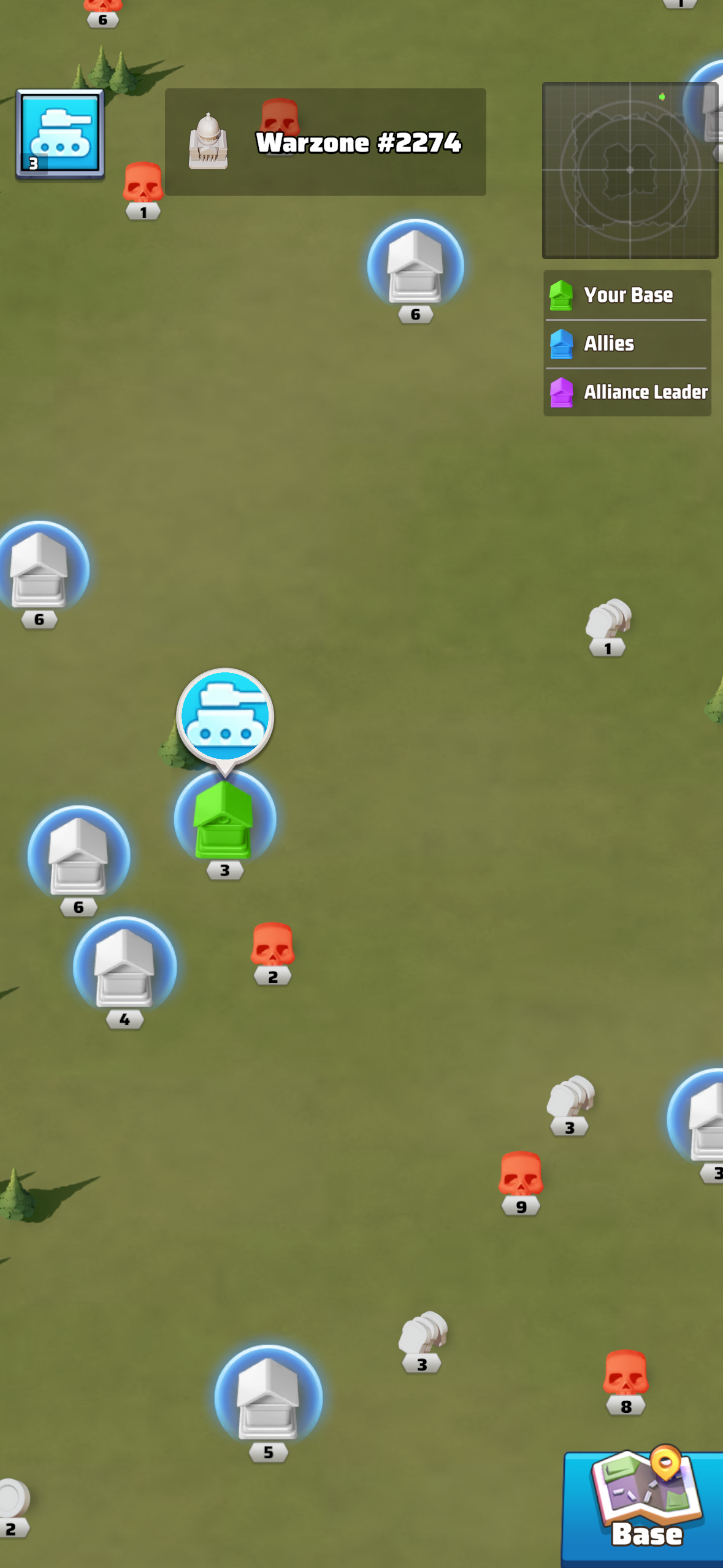
When you leave your base you are dropped into a warzone: a single shared map, identified by number — Warzone #2274 in the screenshots below — populated by thousands of other real players. A radar in the corner shows the whole battlefield at once: a circular frontier, your position inside it, and all the contested ground in between.
The warzone map zoomed into the settlement corridor (Warzone #2274). Numbered shields mark capturable territory: two level-1 Villages at the edge, level-2 Chemical Plants in the mid-zone, a level-5 Metropolis at the center, a level-3 Power Plant flanking it, a level-4 Town below. Each tier is a bigger prize and a harder fight to take and hold. The color-coded legend (green = your base, blue = allies, purple = alliance leader) makes the entire alliance visible as geography — not a chatroom, but a territory you can see and defend.
The map is not decoration. Where you sit on it, who sits beside you, and what you can reach are the central strategic questions of the entire game.
Reading the Map: A Taxonomy of Targets
Every icon on the warzone is a decision waiting to be made. They fall into four families:
Capturable settlements. Villages, Towns, a Metropolis, and industrial sites — Chemical Plants, Power Plants, Military Bases — each stamped with a level from 1 upward. Holding one feeds resources and buffs to you and your alliance; the higher the tier, the bigger the prize and the harder the fight to take it and keep it.
Zombie infestations. The red skull markers, ranked by level — a level-1 nuisance up to a level-9 monster. These are the PvE targets: relatively safe growth that pays out experience and resources, and the bridge back to the shooter the ads promised.
Resource tiles. Stacks of food and iron scattered across the map — the slow, safe way to feed the base.
Other players. Bases dotted everywhere — your own in green, allies in blue, your alliance leader in purple, and everyone else a potential ally, target, or threat.
The same warzone read at maximum zoom-out: the density of the battlefield becomes clear. Grey shields with level numbers are player bases — dozens of real opponents visible simultaneously. Red skull icons mark zombie infestations distributed across the open ground. Your own base glows green with the tank commander icon. The minimap radar in the top-right maps all of this into a scannable circle. At this zoom, the world looks exactly like a board game — because strategically, it is one. Every icon is a question: is it worth sending a march?
The March System — Your Real Constraint
Here is the mechanic that makes the map a strategy game rather than a menu: you can only send a handful of marches at once. A march is a squad of troops, led by a hero, sent out to do exactly one job — gather a resource tile, clear a zombie, attack a base, reinforce an ally, or join an alliance rally. Each march takes real travel time to arrive and to return.
That scarcity is the entire puzzle. With only two or three marches available, every one carries an opportunity cost. Gather safely, or hunt zombies for faster growth? Defend a teammate under attack, or commit to the rally across the map? Marches are the true currency of the world map, and rationing them well is what separates a strong commander from a weak one — which is exactly the kind of decision a player keeps turning over while the app is closed.
Capturing Ground, and the Capitol
Settlements are not just income — they are territory. Alliances coordinate to capture and hold cities, push their borders outward, and contest the prize at the center of every warzone: the Capitol. Holding it confers server-wide status and bonuses. Around this orbit the headline competitive modes — City Clash, Alliance Duel, server-versus-server invasions — each of which turns the quiet map into a scheduled, high-stakes war.
PvP Has Teeth
Attacks are not bloodless. When a base is hit, troops die, resources are stolen, and buildings catch fire. Losses are real and slow to recover. So the map runs a constant, low-grade threat state: a player who logs off "exposed" — shield down, an enemy nearby — can return to a looted, burning base. That dread is itself a retention mechanic, and one of the strongest reasons in the whole game to buy a shield, a defensive boost, or simply more troops.
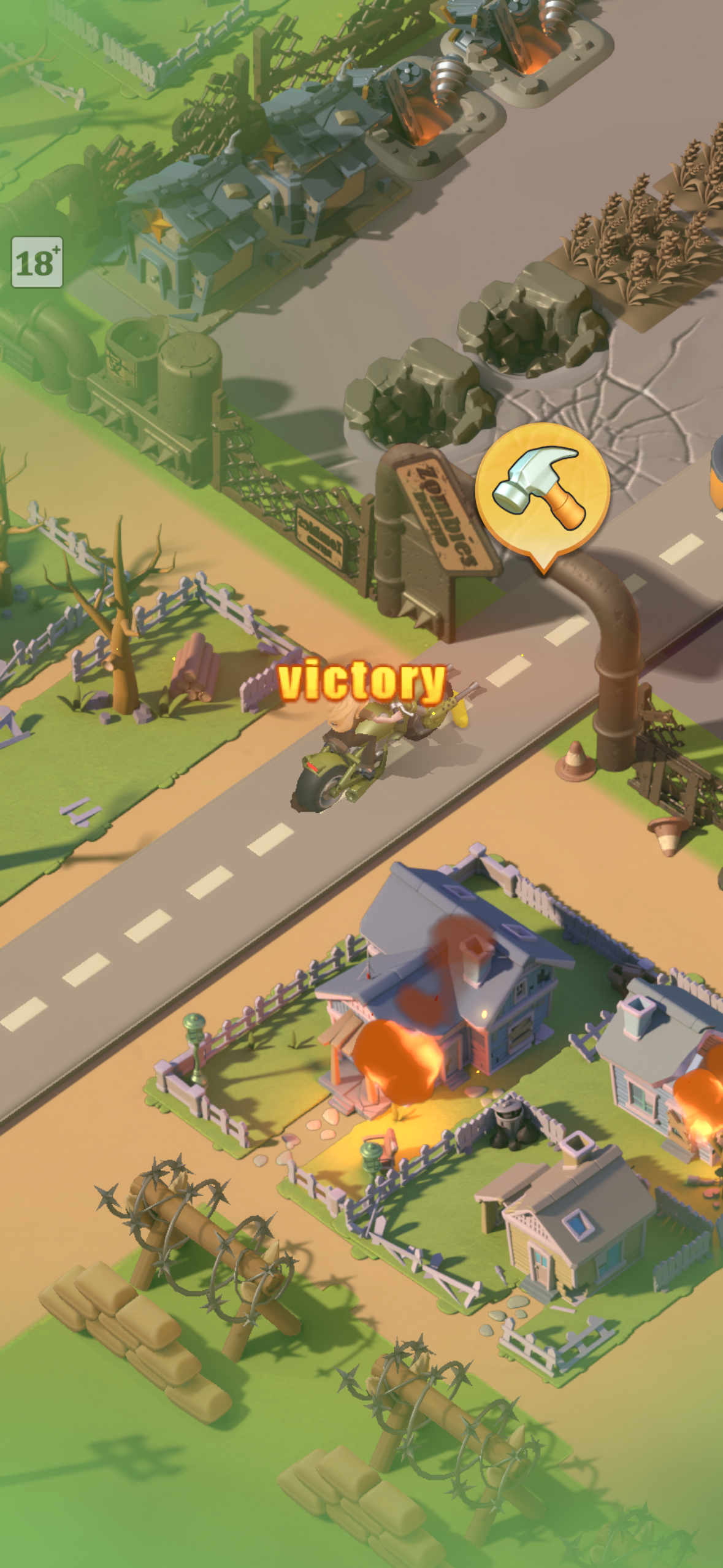
The aftermath of a successful attack: "victory" floats in yellow above the road as a motorcycle scout returns. To the right, the conquered settlement burns — roof on fire, structures flickering orange. Dead and scorched trees line the background. This is what winning looks like in Last War: not a clean trophy screen, but a smoldering proof of force. The burning buildings are a countdown — the defender will repair, regroup, and the territory will be contested again.
The victory aftermath screen conveys something most mobile games deliberately soften: war has a physical cost on both sides. The burning buildings are not an animation that fades immediately. They persist on the map, cost the defender repair time and resources, and are visible to every observer on the map. Victory is territorial and public — which makes defeat feel exactly the same way. This visibility loop turns every raid outcome into social information, and that social layer is a constant source of both motivation and shame driving further investment.
Why the Map Is a Genius Retention Device
The world map quietly does three things no base screen can:
It makes the alliance physical. Allies are not names in a chat window — they are bases beside yours, color-coded, visibly depending on you. Proximity manufactures obligation.
It makes the stakes spatial. A threat is not abstract; it is an enemy march crawling toward a dot you care about, in real time.
It never resolves. Territory is always contested, the Capitol is always held by someone, a march is always out. The map guarantees there is always a reason to come back and look.
Part Five — Alliances: The Social Engine, and the Real Hook
If the minigame is what converts players, alliances are what truly traps them. Multiple analyses converge on this: the alliance system is the single strongest driver of both addiction and spending.
What Alliances Do
Mutual aid: members help speed up each other's timers with taps — so being in an active alliance literally makes the game faster.
Shared defense and coordinated offense: members reinforce bases, rally to attack, and teleport near one another.
Alliance-exclusive events with rewards impossible to access alone.
Territory and politics: alliances claim land, capture the Capitol, and forge and break treaties — "part political simulation, part survival game."
Players repeatedly describe their alliance as a "second family." That is not a marketing line — it is a recurring sentiment across the game's community, and it is the most powerful retention force the game has.
Why This Creates Addiction
Belonging. A "second family" is a profound retention force — the strongest one there is. You are not logging in for a game; you are logging in for people.
Social obligation and guilt. Skip a day and your timers go un-helped, you miss the rally, you let teammates down. The game converts playing into a duty owed to other humans.
Conformity-driven spending. When everyone in your alliance spends, spending becomes normalized — it stops feeling like a purchase and starts feeling like pulling your weight.
Peer-policed retention. Real teammates notice and message you if you go quiet. The game outsources its retention pressure to your friends.
The dark side is well documented: the game's own community forums contain posts about Last War damaging marriages and family relationships. From the publisher's revenue perspective, that is not a bug — it is the social loop working exactly as designed.
Part Six — Events and Live Ops: The Tempo Machine
A 4X game lives or dies on live ops — the constant rhythm of timed events. Last War's cadence is considered best-in-class, and it shows up directly as large, regular revenue spikes its competitors cannot match.
The Event Stack
Onboarding events — Rookie Challenges, Rookie Pass, Daily Progress, Top Commander — front-load rewards and lock in a routine in the first week.
Arms Race — a recurring daily event where specific actions score points toward reward tiers. It tells you what to do today, and rewards you for doing it now.
Duel VS / Alliance Duel — a weekly head-to-head between alliances, where different days reward different activities. This is "co-opetition" — cooperation and competition fused — generating intense social pressure to spend.
Capital / City Clash — large-scale war where the strongest alliances fight to capture cities and the Capitol itself.
Seasons — major content resets (The Crimson Plague, Wild West, Lost Rainforest, and more), each with new maps, mechanics, heroes, and battle passes. New seasons deliver some of the biggest revenue lifts of the year.
Cultural tie-ins — Halloween, Christmas, even the 2024 Summer Olympics.
Why the Stack Is So Powerful
It removes the burden of self-direction. A tired player does not decide what to do — the event decides. That kills the number-one churn risk in deep strategy games.
It synchronizes everyone. Scheduled events put the whole alliance online at once. Social density rises, and so does fear of missing out.
It manufactures urgency. Time-limited currencies, limited stores, and "today only" discounts mean you buy not because you want it, but because the discount is expiring.
Part Seven — The Monetization Architecture
Last War runs no in-game ads. It monetizes 100% through in-app purchases. For a retention-focused mid-core game this is correct — ads would interrupt the loop. The whole design is instead about a long, escalating spending relationship.
The Conversion Ladder
1The first-purchase trap. New players see a pack at $0.99 to $2.99 stuffed with disproportionate value — an extra construction line, a UR hero. The goal is not the dollar; it is to break the "I am a non-payer" identity. The pack stays small enough that you still feel like a free player.
2Habitual small spends. A steady drip of well-timed offers — right when you are short on speed-ups, right when an event needs one more push.
3Bundles and escalation. Small offers are shelved beside bigger bundles, scaling up for players willing to invest more.
4VIP and premium passes. A VIP track grants permanent boosts; seasonal battle passes hand out hero shards — turning spending into a subscription-like habit.
5Heroes as the whale ceiling. Top UR heroes behind direct purchase give the biggest spenders a near-unlimited place to put money.
Designed for Every Wallet
The old 4X playbook monetized only "whales." Last War deliberately monetizes whales, dolphins, and minnows — and keeps a robust free path so non-payers stay in the world as content (opponents, alliance members, an audience) for the payers. A notable shift: Last War leans on direct sales over pure gacha for key heroes, because players increasingly prefer a guaranteed outcome to a probabilistic one — and guaranteed outcomes convert better.
A Worked Example: "Spend More, Get More"
The clearest window into the machine is a recurring event called Spend More, Get More.
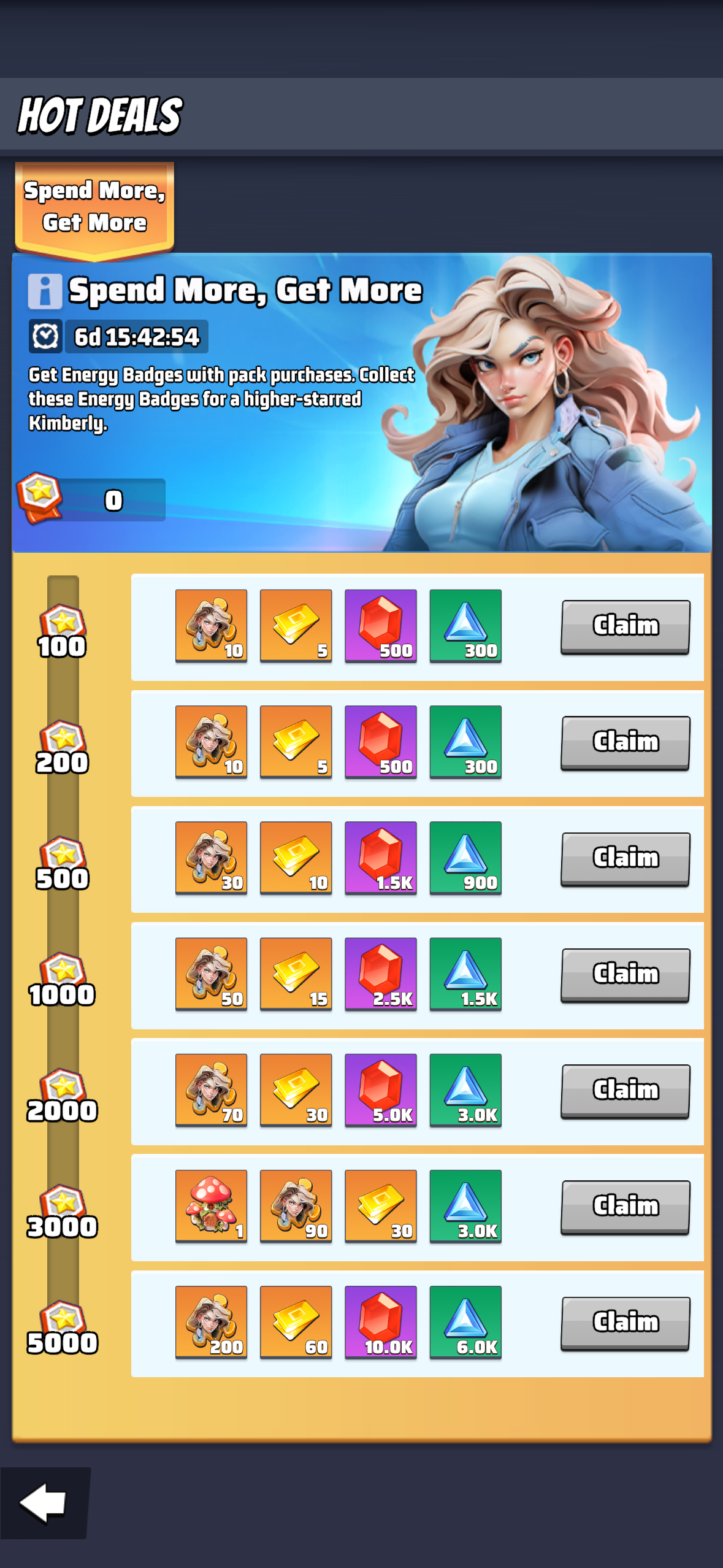
"Spend More, Get More" under the Hot Deals tab: every real-money pack purchase earns Energy Badges. Seven tiers — 100, 200, 500, 1,000, 2,000, 3,000, 5,000 badges — each with a "Claim" button and a stack of hero shards, gems, and speed-ups. Kimberly's portrait promises a higher-starred hero at the top rung. A 6-day 15-hour countdown frames the entire ladder. The badge counter reads zero — you have not started — but the ladder is already structured to make you feel like you are already partway through something worth finishing.
The design rewards a close read, because it shows how completely the game gamifies spending itself:
Spending earns a currency. Every real-money pack you buy pays out Energy Badges. Badges buy nothing directly — they are simply accumulated.
The badges fill a progress bar. A seven-rung ladder — 100, 200, 500, 1,000, 2,000, 3,000, 5,000 badges — each rung a claimable chest of hero shards, gold and gems.
The prize is power. The headline reward is enough shards to raise a specific hero to a higher star rank — a permanent, competitive gain, not a cosmetic one.
A countdown frames it. The whole ladder expires in days. The clock, not desire, sets the pace.
Every lever that makes the game compulsive is here turned on the player's wallet. There is a visible progress bar, so spending feels like advancing. There is the endowed-progress effect — once you sit at 1,400 badges, the 2,000 rung feels like a set worth completing rather than a fresh decision. There is a deadline. And because the reward is competitive, opting out means falling behind. The purchase stops feeling like a purchase and starts feeling like a level you are already partway through.
Why It Is a Success
Pulling every thread together, Last War's success rests on five pillars:
1Genre fusion. It fused hyper-casual acquisition — cheap, universal, viral — with 4X monetization, one of the most lucrative models in mobile. It gets the funnel and the revenue per user. Almost nothing else does both.
2The best onboarding ramp in the genre. By making the fake ad real and using it as a graduated tutorial, it solved 4X's fatal flaw: a brutal, intimidating first ten minutes.
3Veteran execution. First Fun did not invent the 4X loop — they are Clash of Kings and Top War veterans executing a known formula at an exceptionally high level, especially in live ops.
4Marketing that weaponized its own criticism. Instead of hiding from "misleading ads" backlash, the Antony Starr (Homelander) campaign leaned in — "the developers made a real game based off the fake game in the ads." That alone drove 12.5 million-plus downloads and a number-one US ranking.
5A pragmatic growth trade. Management knowingly accepts weak long-term retention for a massive, cheap top-of-funnel — because the players who do stay monetize so well that the equation prints money.
How It Creates Addiction
"Addiction" here means compulsion loops engineered to override a player's own judgment about how to spend their time and money. Last War stacks nearly every known behavioral lever.
Psychological leverHow Last War uses it
Variable-ratio rewardGacha hero pulls and randomized loot — the same schedule that powers slot machines.
Visible progressionNumbers always rising — squad size, power score, HQ level, troop tiers. Legible growth is pure dopamine.
Zero-friction entryThe swipe-only minigame means anyone converts; no skill barrier filters players out.
Commitment and consistencyThe onboarding ramp eases you in so gradually you never consciously decide to commit — but you are committed.
Sunk costMonths of build time, an irreversible research tree, a leveled roster — quitting means destroying a large personal investment.
Loss aversionReal PvP losses, troop-stealing traps, raids while offline. The game then sells you protection from the pain.
FOMO and artificial scarcityTime-limited currencies, expiring packs, today-only discounts, seasonal exclusives. The clock drives the purchase.
The appointment mechanicReal-time timers and scheduled events turn the game into appointments threaded through your day.
Social belongingThe alliance as a second family. You log in for people — the strongest retention force there is.
Social obligation and guiltSkipping a day fails your teammates — missed rallies, un-helped timers. Playing becomes a duty owed to humans.
Social proof and conformityWhen the whole alliance spends time and money, spending feels normal — pulling your weight, not a purchase.
Identity preservationFirst purchases are kept tiny so you can spend and still believe you are a free player.
No choice paralysisDaily events always tell you exactly what to do today — eliminating the "I do not know what to do, I will quit" exit.
Gamified spendingSpend-to-earn ladders such as "Spend More, Get More" turn real-money purchases into a progress bar with its own rewards and deadline.
Stamina gatingThe minigame runs on energy that refills on a real-time clock — rationing the fun and scheduling your return visits.
Real-time appointment settingEnergy displayed with a local clock time (not a countdown) turns a game mechanic into a literal calendar meeting — the game books a slot in your day.
Parasocial attachmentHero characters with names, faces, and opening dialogue ("Let me call you Commander") create emotional investment that transcends gameplay and resists rational quitting.
Production-cap loss aversionIdle buildings stop generating after 8 hours — the gap in production is only visible when you return, turning absence into a quiet, persistent guilt.
The decisive combination is the last four social levers. A solo game you can put down. A game where real friends are counting on you, will notice your absence, and where spending is the group norm is something else entirely. That is why the game's own community openly discusses it harming real-world relationships — the social loop is not a side effect, it is the retention engine, working as designed.
The Flip Side — Where the Machine Strains
For an honest picture, the weaknesses:
Weak long-term retention. iOS US retention runs roughly D1 34%, D7 11%, D30 4% — well below close competitor Whiteout Survival (around 42%, 17%, and 8%). The "misleading ad" funnel pulls in many players who bounce fast.
Acquisition dependency. Because so many players churn, the model requires constant, expensive user-acquisition spending to keep growing.
Reputation cost. A large share of store reviews are one-star — driven by ad-versus-product mismatch, pay-to-progress frustration, and a controversial refund policy notable enough to reach its Wikipedia page.
Pay-to-progress ceiling. Free players can compete by playing smart, but paying players advance dramatically faster — a persistent source of resentment.
None of this has stopped the revenue. But it defines the strategic question for First Fun: a game this dependent on buying new players, with a back door this leaky, must eventually fix retention or keep paying ever more to refill the top of the funnel.
The One-Sentence Verdict
Last War: Survival is a veteran-built 4X strategy game disguised as a hyper-casual reflex game — it uses a cheap, universal minigame to convert a massive audience, a brilliantly graduated tutorial to smuggle them into a deep strategy machine, and a stack of timers, collection loops, scheduled events, and above all real-world social obligation to convert that machine into a habit people genuinely struggle to put down.
For anyone designing engaging experiences, the lesson is double-edged: the same mechanics that make a game irresistible — visible progression, social belonging, well-timed rewards — are extraordinarily powerful, and they carry a real responsibility to be used in service of the player, not against them.
Sources and Further Reading
Naavik — "Why Last War Is Winning the 4X Game"
MAF — "Last War Survival: The Secrets Behind Its $2.6 Billion Revenue"
FoxData — "How Last War: Survival Raked in $1.6 Billion in 18 Months"
GFR Fund — "From Gameplay to Marketing: Inside Last War"
Wikipedia — "Last War: Survival Game"
Ruthless Reviews — "Last War Survival Game Review"
Arcade Punks — "Is Last War: Survival a Real Game? Complete Analysis"
game designLast War Survivalmobile gamesgamificationplayer retentiongame monetization4X strategyaddiction mechanicslive ops
Free Newsletter
Get Gamification Insights Delivered Weekly
Join brand managers and marketers getting our best content on branded games, engagement strategies, and interactive marketing — no spam, unsubscribe anytime.
No spam. Unsubscribe anytime. We respect your inbox.